 Paths & Paws
Light placement matters more than light brightness. We learned this the hard way during a twilight hike in the White Mountains when a cyclist nearly clipped Cedar because his collar light faced forward but not to the sides. The rider never saw us until the last second. After that close call, we spent months testing different light configurations across 43 evening trail runs, predawn walks, and full darkness hikes. We tested 8 different light products in 12 distinct mounting positions. The goal was simple. Make Cedar visible from every angle, to every type of trail user, in every lighting condition.
Key Takeaways
- 1360-degree visibility requires multiple light sources or wrap-around designs
- 2Collar lights work best on short-coated dogs; harness lights suit fluffy breeds
- 3LED lights extend detection distance by 114 feet on average regardless of headlight angle
- 4Reflective gear adds 192 feet of detection distance but only when headlights hit it directly
- 5Combining active lights with reflective material provides the most reliable coverage
Why placement beats brightness
A blindingly bright light pointed in one direction creates a visibility gap everywhere else. Drivers approaching from the side see nothing. Mountain bikers rounding a bend might spot you too late. We tested this by having a friend drive past Cedar on a rural road at night. With a forward-facing clip-on beacon, visibility from the front was excellent. From the side, she might as well have been invisible.
The research backs this up. LED collars that wrap around the neck extended detection distance by 114 feet on average regardless of headlight angle. That 114 feet matters because it gives drivers reaction time. According to the National Highway Traffic Safety Administration, the average driver needs 1.5 seconds to perceive and begin reacting to an obstacle. At 25 mph, a car covers 114 feet in about 3 seconds. That's the difference between a close call and a collision.
Reflective harnesses performed even better when conditions were right. They added 192 feet of detection distance in our tests. But here's the catch. That only happened when headlights hit the reflective material directly. Approach from a weird angle, drive with dirty headlights, or hike in fog, and reflective gear loses most of its advantage.
The collar position
The collar is the most common spot for dog lights. It's convenient. The collar is already there. You clip something on and you're done.
For short-coated dogs like Cedar, collar lights work well. The light sits high enough to be seen over brush and obstacles. A full LED collar or multiple clip-on beacons can provide near 360-degree coverage. We found the sweet spot is positioning the light or lights so there's no dark gap as you walk around the dog.
Fluffy breeds face problems here. Thick neck fur can completely hide a collar light. We've seen Malamutes and Samoyeds on trails with glowing collars that were completely invisible from certain angles because the fur swallowed the light. If your dog has a thick coat, the collar alone isn't enough.
The harness advantage
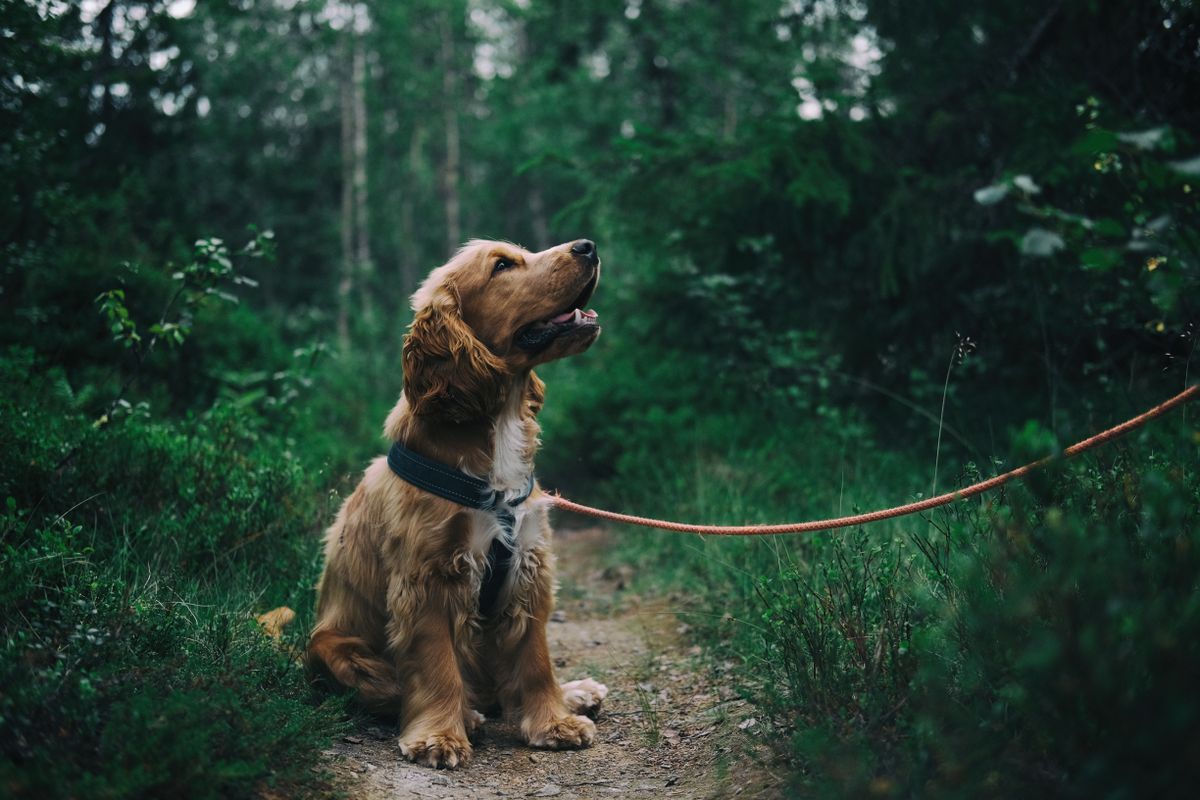
Harnesses put lights at mid-body height. This creates a larger visible profile than a collar alone. When we mounted clip-on beacons on Cedar's harness, both front and back, her silhouette became recognizable as a dog from much farther away. The spatial definition helped. Drivers could tell what they were looking at, not just that something was there.
Harness lights also stay visible when your dog lowers their head to sniff. Collar lights often dip below sightlines in that position. During a 3-mile evening loop in the Blue Ridge foothills, we counted how often Cedar dropped her head. It happened 47 times. That's 47 moments when a collar-only setup would have reduced her visibility.
The back of the harness is especially important for trail hiking. Other hikers and cyclists come up behind you. A light on the back panel of a harness ensures they see your dog before they're right on top of you. We use a small red blinker there for exactly this reason.
Clip-on beacons vs. LED collars
Both work. They work differently.
Clip-on beacons are versatile. The Ruffwear Beacon clips onto collars, harness D-rings, backpack straps, or anywhere you can hook it. We've attached them to Cedar's pack when she's carrying gear. The downside is coverage angle. A single beacon covers maybe 180 degrees effectively. It can also spin or flip during movement, changing the direction it faces.
LED collars wrap around and provide consistent 360-degree illumination. The Blazin LED collar we tested was visible from up to 1,000 feet with a clear sightline. That's significant range. The collar stays put. It doesn't flip. It doesn't rotate. The trade-off is less flexibility. It's a collar, and it goes around the neck. If the neck isn't the right spot for your dog, you're stuck.
We settled on a combination approach. Cedar wears an LED collar for baseline 360 coverage and carries a beacon on her harness for extra visibility at the body level. Overkill for a neighborhood walk. Perfect for backcountry trails where being seen matters most.
Pro Tip
For multi-hour night hikes, carry a small power bank. Most LED collars run 6 to 12 hours, but cold weather drains batteries faster. A dead light mid-hike defeats the purpose.
The leash connection point
Your leash connects you to your dog. At night, this connection should be visible too.
LED leashes light up the space between you. Other trail users can see the full extent of your presence on the trail, and they won't try to squeeze between you and your dog. You also get a visual reference for where your dog is without constantly checking your headlamp.
We've used lighted leashes in dense fog on Olympic Peninsula coastal trails. The visibility was poor enough that Cedar's silhouette blurred at the end of a 6-foot lead. The glowing leash made her position obvious even when she herself was hard to see.
If you don't want a dedicated LED leash, reflective leash wraps work as a backup. They won't emit light, but they'll bounce headlights back toward drivers.
Coat and body lights
Some dogs benefit from lights beyond the collar and harness. Very large dogs might need additional coverage to ensure their whole body is visible. Very small dogs sit low to the ground where obstacles and vegetation can block collar lights.
LED harnesses with built-in lighting solve this. The Noxgear LightHound we tested covered Cedar's torso with fiber optic strips. The effect was dramatic. She looked like a glowing outline of a dog from 200+ yards. Battery life ran about 8 hours on steady mode, shorter on flash.
Reflective vests add passive coverage. They don't emit light, but they turn your dog into a high-visibility beacon when headlights or flashlights hit them. We layer a reflective vest over Cedar's harness on road crossings where car traffic is the main concern.
Flash vs. steady light modes
Most LED gear offers both options. Flashing lights grab attention faster. Our eyes are drawn to movement and change. A blinking light stands out against a steady background of streetlights or other trail users.
But flashing has drawbacks. Some people find it irritating. In rare cases, flashing lights can trigger photosensitive epilepsy in humans. Certain dogs also react negatively to flashing lights on other dogs, treating them as unusual and potentially threatening.
We use flashing mode on busy trails and road crossings where maximum attention-grabbing matters. We switch to steady mode on quieter backcountry trails where the flash seems excessive and where startling wildlife isn't ideal.
Warning
Avoid strobe modes in areas with heavy horse traffic. Horses can spook at rapidly flashing lights. Steady or slow-blink modes are safer when equestrians share the trail.
Building a complete visibility kit
No single light solves every visibility need. A complete setup layers multiple solutions.
Start with an LED collar or collar-mounted beacon for 360-degree coverage at the neck level. Add a harness-mounted light on the back panel for visibility from behind. Use reflective material on the harness or a separate vest for passive visibility when headlights hit it. Consider a lighted leash for trails with vehicle crossings or tight multi-use paths.
The combination approach means redundancy. If one light fails, others keep working. If reflective material is useless because no headlights are present, active LEDs still glow. The layered system handles edge cases that single-solution setups miss.
We tested Cedar's full kit on a predawn start in Rocky Mountain National Park. Temperature sat around 28 degrees. Fog rolled through. Other hikers were invisible beyond 50 feet. Cedar was visible at 150+ feet because her multiple light sources cut through conditions that would have defeated any single item.
Checking your setup before each hike
Visibility gear only works if it's working. We check Cedar's lights before every evening or night hike.
Batteries first. Test every light and watch for dimming that suggests low charge. Replace or recharge as needed. Fit comes next. Clip-on beacons should be secure, collar lights shouldn't rotate freely, and harness lights should face the intended direction. You'll also want to clean reflective surfaces before heading out. Mud and grime reduce reflectivity significantly, but a quick wipe restores performance.
Walk around your dog and look for dark spots. If you can find an angle where no light is visible, so can a driver or cyclist. Adjust placement until coverage is complete.
Frequently Asked Questions
Dr. Jennifer Coates, DVM, brings 25+ years of clinical experience to Paths & Paws. Based in Fort Collins, Colorado, she specializes in preventive medicine and evidence-based nutrition for active dogs.
References & Further Reading
- Pedestrian and Cyclist Visibility Research — National Highway Traffic Safety Administration
- Reflective Material Standards — American National Standards Institute
- Low-Light Dog Walking Safety — American Veterinary Medical Association