 Paths & Paws
You reach a rock face and realize you need both hands to climb. Your dog stares at you, ready to follow. But if they scramble up while you're mid-climb, you can't spot them. You can't help them. And if they slip, you're in no position to react. This is where the "wait" command becomes a safety tool, not just a trick.
What You'll Learn
- 1How 'wait' differs from 'stay' and why it matters for scrambling
- 2Building duration and reliability before hitting technical terrain
- 3Adding distractions that mimic real trail conditions
- 4Transitioning the command from flat ground to rocky environments
- 5Common mistakes that undermine the behavior under pressure
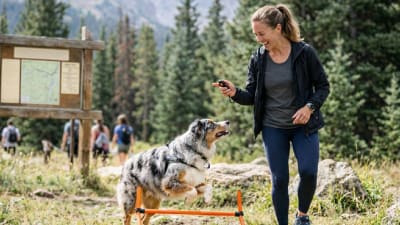
Bodie is nine years old now. He's been my scrambling partner for nearly a decade, and the "wait" command has become second nature to both of us. When I approach a boulder problem, he automatically settles into position. He watches me climb, he watches me reach the top, and he holds until I release him. That reliability didn't happen overnight. We built it deliberately over months of training before we ever trusted it on actual technical terrain.
Why wait matters more than stay
The "stay" command typically means hold position until I return to you. It's static. You leave, you come back, you release. The "wait" command is different. It means hold position until I give you the next instruction. That instruction might be a recall. It might be a release to follow. It might be a direction to take a specific route up.
This distinction matters for scrambling because you won't always return to your dog. Sometimes you'll climb up, find your footing, turn around, and call them to join you. Other times you'll need them to take a different path while you spot from above. The "wait" gives you flexibility that "stay" does not.
We trained both commands separately so Bodie understands the difference. Stay means I'll be back. Wait means something else is coming. That clarity helps him make the right choice when it counts.
What you need to get started
The equipment list is simple. High-value treats work best during initial training. Small pieces that your dog can eat quickly without breaking focus. A treat pouch keeps rewards accessible.
A long line helps during the generalization phase. Fifteen to thirty feet gives your dog room to make choices while keeping them safe. Choose lightweight material so they barely notice it dragging.
You'll also want access to varied terrain as training progresses. Start on flat ground. Move to gentle slopes. Progress to rocky areas where scrambling actually happens. Each environment adds challenge and builds reliability.
Reward Timing
Speed matters more than treat quality during duration training. A treat delivered within one second of the correct behavior builds stronger associations than a high-value treat delivered three seconds late.
Building the basic behavior at home
Start indoors with zero distractions. Your dog should be loose, standing or sitting naturally. No formal obedience positions required.
Say "wait" clearly. Take one step backward. If your dog holds position for even half a second, mark with "yes" and reward. Return to them for the treat delivery rather than calling them to you. This reinforces the idea that staying put is what earns the reward.
Repeat. One step. Mark. Reward. One step. Mark. Reward. Most dogs figure out the game within five to ten minutes. Standing still while you move away equals treats.
Gradually increase your distance. Two steps. Then three. If your dog breaks position, don't correct them harshly. Simply reset and ask for less distance next time. Success builds confidence better than failure.
Work in short sessions. Three to five minutes is plenty. Quit while your dog is still engaged and succeeding. You want them eager for the next round.
Adding duration before distance
Many trainers rush to add distance too quickly. Duration matters more for scrambling. Your dog might only be ten feet away, but they need to hold that position for two or three minutes while you climb.
After your dog reliably holds position for a few seconds at short distance, start building time. Ask for wait. Take two steps back. Count to three in your head. Then mark and reward.
Gradually extend the count. Five seconds. Ten seconds. Thirty seconds. A full minute. If your dog breaks, you've pushed too fast. Drop back to a duration they can succeed at and rebuild.
Proofing against distractions
Indoor training is just the beginning. Real scrambling happens with wind, wildlife, other hikers, and interesting smells competing for your dog's attention.
Start adding distractions systematically. Practice in your backyard where squirrels might appear. Practice at a park with distant foot traffic. Practice near a trailhead during busy hours.
Each new distraction will initially weaken the behavior. That's expected. When your dog holds position despite the distraction, reward heavily. Multiple treats. Excited praise. Make it clear that holding "wait" during challenging moments is extra valuable.
We built a progression over several weeks with Bodie. First we practiced in quiet outdoor spaces. Next came distant movement. After that, we practiced with other dogs visible. Eventually we worked up to holding wait while I threw a ball past him. If he held position while a ball rolled by, he got a jackpot reward.
Moving the training to slopes and rocks
Flat ground training doesn't automatically transfer to technical terrain. The environment changes everything. Your dog is now on uneven footing. You're moving in unfamiliar ways. The stakes feel different.
Find a gentle slope with some rocks. Practice wait while standing a few feet above your dog. The new angle and terrain will reset some of the training. Expect to go back to basics briefly.
As your dog succeeds on easier terrain, find more challenging spots. A boulder field works well. Practice wait while you climb onto a low rock. Then practice while you climb slightly higher. Build the difficulty incrementally.
Safety First
Never practice on terrain that would actually injure your dog if they slipped or fell. Training spots should mimic real scrambles without the real consequences. Save actual technical terrain for after the behavior is rock solid.
Adding a clear release cue
Your dog needs to know when "wait" ends. Without a clear release, they might hold forever or they might guess when to move. Neither is safe on technical terrain.
Choose a release word. "Okay" works. So does "free" or "break" or "come." The specific word matters less than consistency. Use it every single time you end a wait.
Practice the full sequence. Ask for wait. Build duration. Release with your chosen word. Reward immediately. Your dog learns that the reward comes after the release, which makes the release itself valuable.
On scrambles, your release might transition into a recall. Wait. Follow with "come" or "hike" or whatever cue means join me up here. The wait holds them in place until you're ready for them to move.
When your dog should wait versus climb independently
Some dogs develop strong scrambling instincts and learn to navigate technical terrain on their own. This is great when appropriate. But even skilled scramblers need "wait" for specific situations.
When you need both hands free to climb, your dog waits. When the route requires you to spot them from above, your dog waits. When the terrain is marginal and you need to assess it first, your dog waits.
We've found that Bodie actually prefers waiting for a signal on challenging scrambles. He's learned that my guidance leads to easier routes. The wait isn't restriction. It's information. He's watching me solve the problem so he can benefit from my route-finding.
Common mistakes that undermine reliability
Releasing too early trains your dog to expect short waits. If you always release after ten seconds, they'll start anticipating the release at ten seconds. Vary your duration randomly. Sometimes five seconds. Sometimes two minutes. Keep them genuinely waiting for your signal.
Inconsistent release cues confuse dogs. If you sometimes say "okay" and sometimes just walk away, your dog has to guess when wait ends. Pick one release word and use it every time without exception.
Training only in easy environments creates a dog who waits at home but not on trail. Generalize the behavior to many locations before trusting it in high-stakes situations.
Correcting breaks harshly can create anxiety around the command. A dog who fears failure may refuse to hold wait because the pressure feels overwhelming. Keep training positive. Reset after breaks and rebuild success.
Skipping duration work leaves you with a dog who waits for three seconds then wanders. Real scrambles require minutes of holding position. Build that duration systematically.
Putting it all together on trail
The first real test should be a mild scramble. Something you could navigate while holding a leash if needed. This gives you a safety margin while you assess your dog's reliability.
Approach the rock. Ask for wait. Watch your dog's body language as you begin to climb. A dog who holds position with relaxed focus is ready. A dog who strains forward or whines might need more training.
Climb a few feet. Pause. Check your dog. Continue climbing. Reach a safe stance. Release and guide them up.
Over time, you'll develop a rhythm together. Bodie now anticipates when a wait is coming. He sees me evaluating terrain and automatically settles into a ready position. That partnership took years to develop, but it started with basic training in our living room.
Frequently Asked Questions
The "wait" command transforms scrambling from a stressful negotiation into a coordinated dance. Your dog holds position while you solve the problem above them. You find your footing, assess the best route for them to follow, position yourself to help if needed. You release, and they join you. That sequence repeats up every scramble, building trust and safety with each repetition. Start training now, long before you need it on the mountain.
Sarah is a certified canine fitness trainer with a background in veterinary rehabilitation. She focuses on injury prevention, proper conditioning, and training techniques for trail dogs.